Ansible Fundamentals and Architecture
Understand control nodes, managed nodes, inventories, playbooks, modules, and Ansible's agentless model.
What Ansible Solves
Configuring one server by hand is manageable. Repeating the same commands across many servers is slower, harder to review, and easy to do inconsistently.
Ansible lets us describe the state we want in YAML and apply it to one or many machines. For example:
- required packages are installed;
- Nginx is running and enabled at boot;
- a configuration file has the expected content; and
- selected users belong to the Docker group.
Instead of documenting a list of manual commands, we keep the server configuration as repeatable code.
The Ansible Mental Model
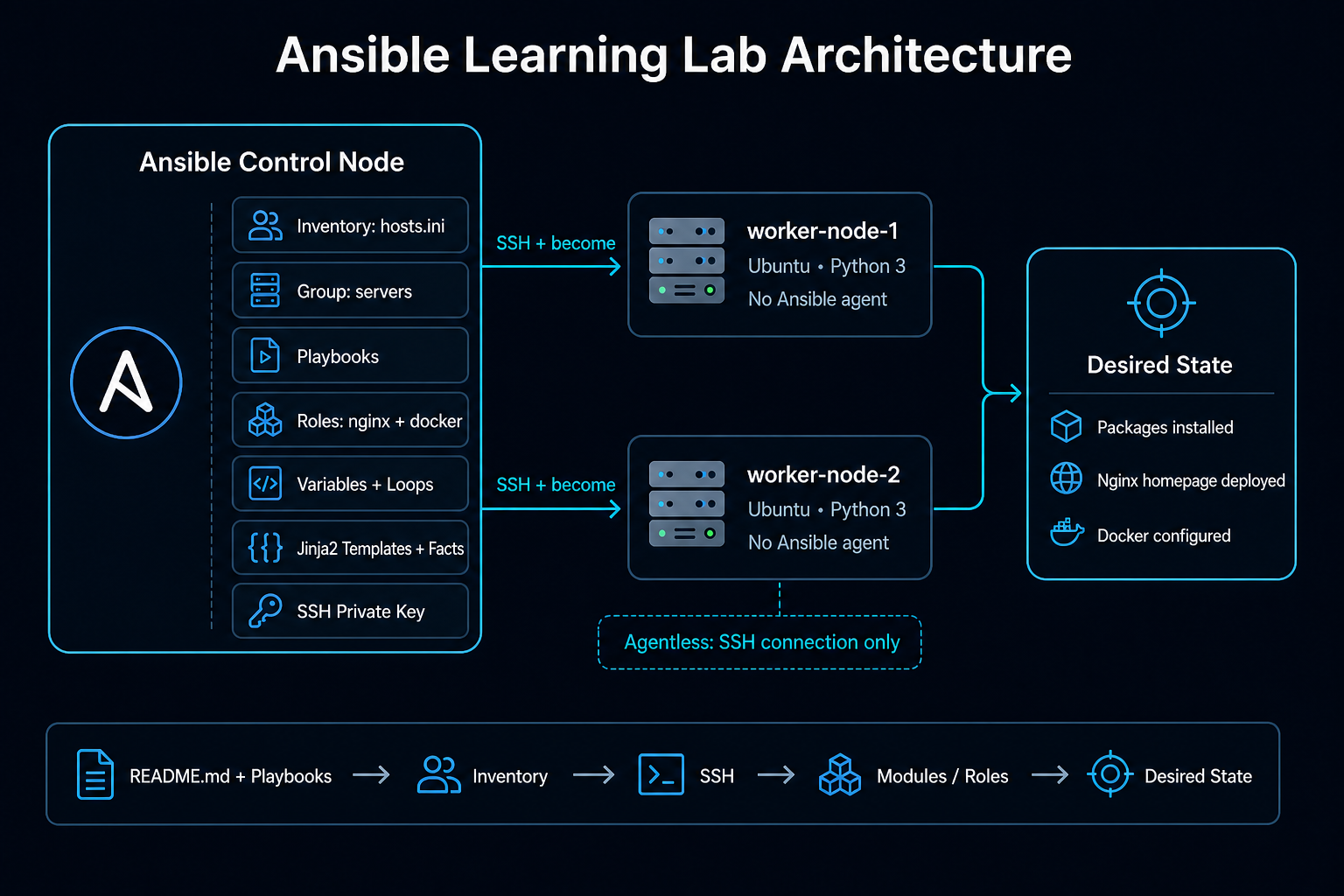
The lab has three important parts:
- Control node: the machine where Ansible is installed and commands are run.
- Managed nodes: the remote servers Ansible configures.
- Desired state: the packages, services, files, and settings those servers should have.
Ansible normally connects through SSH. The managed nodes do not need a permanently running Ansible agent, but they usually need Python so Ansible modules can execute.
Control node
    │
    ├── reads inventory
    ├── reads playbook
    │
    └── connects over SSH
            │
            ├── worker-node-1
            └── worker-node-2
                    │
                    ▼
              Desired state
Inventory, Playbooks, and Modules
Each Ansible layer answers a different question:
| Layer | Question it answers |
|---|---|
| Inventory | Which machines should Ansible manage? |
| Playbook | What automation should run, and on which group? |
| Play | Which hosts, variables, tasks, and roles belong to one operation? |
| Task | What individual action should Ansible perform? |
| Module | How should Ansible perform that action? |
| Role | How can related tasks and files be packaged for reuse? |
The flow in this learning lab is:
hosts.ini
    ▼
servers group
    ▼
playbook
    ▼
tasks or roles
    ▼
Ansible modules
    ▼
Configured servers
Declarative Desired State
Ansible works best when a task describes the state that should exist:
- name: Ensure Nginx is running
  ansible.builtin.service:
    name: nginx
    state: started
    enabled: true
This does not say “start Nginx every time.” It says Nginx must be running and enabled. If that state already exists, Ansible does not need to change it.
Key takeaway The inventory identifies the servers, the playbook describes the automation, and modules move each server toward the desired state over an agentless SSH connection.